
If you have ever wondered how a bolt of chiffon ends up on a cutting table in a New York garment district studio, or how a fashion designer in Los Angeles sources a specific crepe de chine before a production run, the answer runs through a layered supply chain that most buyers rarely see. Understanding how wholesale fabric moves from raw fiber to finished roll helps designers, manufacturers, and independent makers source smarter, negotiate better, and avoid the kinds of delays that blow through a production schedule.
Here is a step-by-step look at how the wholesale fabric supply chain works, and what each stage means for the people buying fabric by the yard or by the roll.
Stage 1: fiber production
Every piece of fabric begins as fiber, either grown or manufactured. Natural fibers like cotton, linen, wool, and silk are agricultural products. Cotton is harvested from plants, wool is shorn from sheep, silk is cultivated from silkworm cocoons. Synthetic fibers like polyester, nylon, and spandex are derived from petrochemical processes and manufactured in industrial facilities.
The source of the fiber sets the foundation for everything downstream. Fiber quality, origin, and processing method will eventually show up in the hand, drape, and durability of the finished textile. A long-staple Egyptian cotton and a short-staple generic cotton are both “cotton,” but they will behave differently in every stage that follows.
At this stage, the supply chain is largely invisible to most fabric buyers. Fiber production happens at scale, often in agricultural regions or chemical processing plants scattered across Asia, Africa, the Americas, and parts of Europe.
Stage 2: spinning into yarn
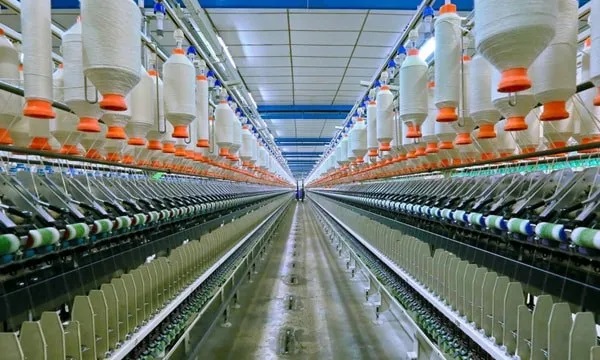
Raw staple fibers are cleaned, carded to individualize the fibers, and sometimes combed to remove short strands for premium-quality lines. From there, they are drawn out and spun into yarn. Spinning mills produce yarn in varying weights and twist levels depending on the end use; a fine cotton voile requires a vastly different yarn construction than a heavy wool suiting.
Yarn quality directly affects how a fabric performs on the loom or knitting machine. Irregularities in spinning can cause uneven texture, pilling, or weak spots in the final fabric. For buyers sourcing wholesale fabric for garment production, this is worth knowing because low-cost fabrics often reflect compromises made at the spinning stage.
Stage 3: the textile mill
Spinning mills hand off yarn to textile mills, or in vertically integrated operations, the same facility handles both. Textile mills are where yarn becomes fabric through weaving or knitting.
Woven fabrics are produced on looms, where lengthwise yarns (warp) interlace with crosswise yarns (weft) in various patterns. Plain weave, twill, satin, and jacquard are all weave structures that originate at the loom. Knitted fabrics are produced by interlocking loops of yarn, either on circular or flat-bed knitting machines. Jersey, ponte, and interlock are knit constructions familiar to most garment makers.
At this stage, fabric typically leaves the loom in what the industry calls greige goods, sometimes also written as gray goods or grey goods. Greige goods are unfinished: they have not been dyed, bleached, or treated in any way. They are the raw material for the next stage of the supply chain.
Textile mills generally operate on very high minimum order quantities (MOQs), typically starting at 1,000 yards for European mills, 3,000 yards for mills in Asia, and 5,000 yards for U.S. mills. This makes direct mill purchasing impractical for most small and mid-size operations.
Stage 4: the converter
This is one of the most important and least understood roles in the wholesale fabric supply chain.
A textile converter purchases greige goods directly from mills, then coordinates the dyeing, printing, finishing, and treating of those raw fabrics before selling them into the market. Converters do not necessarily own the equipment used to process the fabric. Instead, they contract out dyeing and finishing to specialized facilities while managing the specifications, color development, and quality standards themselves.
Converters are the entities that turn a plain undyed fabric into a collection of fashion-forward colors, printed designs, or specialty finishes. They track trends, develop seasonal colorways, and bring finished fabric to the market faster than a mill can because they are not tied to the production constraints of the original weaving or knitting operation.
For buyers, converters offer a practical middle ground. Their MOQs are meaningfully lower than working directly with a mill, and they stock finished fabrics ready for immediate purchase rather than requiring weeks of production lead time. Some converters will accommodate orders of a few hundred yards or even a single roll.
Stage 5: finishing
Whether handled by a converter or by a mill with in-house capabilities, finishing is what makes a fabric usable and market-ready. Finishing covers a wide range of processes:
Dyeing and printing
This adds color and pattern. Piece dyeing colors the whole fabric after it is woven or knitted. Yarn dyeing colors the yarn before weaving, producing structural patterns like stripes or plaids. Screen printing, digital printing, and heat transfer are all methods for adding surface designs.
Mechanical finishing
Including processes like calendering (pressing fabric through heavy rollers for smoothness), brushing (raising a soft nap on surfaces like fleece), and sanforizing (pre-shrinking cotton so it remains stable after washing).
Chemical finishing
Chemical finishing includes treatments for wrinkle resistance, moisture wicking, flame retardancy, and water repellency. Performance fabrics used in activewear and outdoor applications are typically treated at this stage.
After finishing, fabric is inspected for flaws, wound onto bolts or rolls, and prepared for distribution.
Stage 6: the wholesale distributor
Wholesale fabric distributors sit between the converter or mill and the buyer. They purchase finished fabric in bulk and make it available to designers, manufacturers, retail fabric stores, and independent makers in quantities that work for a wide range of business sizes.
This is where the supply chain becomes directly relevant to most fabric buyers. A reputable wholesale distributor carries curated inventory across a broad range of fabric types, maintains consistent stock, and offers pricing that reflects the volume they purchase upstream. Buyers working with a wholesale fabric supplier gain access to a wide selection without the MOQ and lead time requirements of dealing directly with mills or converters.
For buyers sourcing fabric by the yard, wholesale distributors are often the practical point of entry. They absorb the complexity of international sourcing, quality inspection, and inventory management, and pass the benefit of that scale along in the form of accessible pricing and stock availability.
Stage 7: jobbers and secondary market channels
Not all wholesale fabric moves through the primary supply chain from mill to converter to distributor. Jobbers represent a secondary market layer.
A jobber purchases excess inventory. This can include mill ends (leftover yardage from a production run), canceled orders, overstocked converter inventory, or surplus fabric from apparel manufacturers. Jobbers sell this material at reduced prices, often in smaller quantities, to design studios, boutique manufacturers, and retail fabric stores.
Buying from jobbers carries tradeoffs. Pricing is often attractive, but continuity is rare. Once a specific lot is gone, it is gone. For production work that requires consistent yardage across a run, jobbers are not a reliable primary source. For sample work, small-batch design, or experimental projects, they can be a valuable resource.
What this means for buyers sourcing wholesale fabric
Understanding the supply chain gives buyers a clearer framework for evaluating where they are sourcing and what they are actually getting for their money.
Price reflects position in the chain
Fabric priced at or near converter cost is typically only available to buyers purchasing large quantities. When a wholesale distributor offers fabric by the yard at accessible pricing, that price reflects their upstream purchasing volume, not a compromise in quality.
Lead time is tied to inventory position
A distributor with stock on hand can ship in days. A mill producing to order can take eight to twenty-four weeks. Knowing where your supplier sits in the supply chain helps you plan production calendars accurately.
MOQs exist for a reason
Every stage of the supply chain has minimum order requirements that reflect the economics of production or purchasing at that tier. A designer frustrated by a 500-yard minimum at a converter might find better flexibility through a wholesale distributor who has already absorbed that requirement upstream.
Quality control happens at multiple points
Reputable wholesale suppliers inspect for flaws, verify fiber content, and check finishing quality before fabric enters their inventory. When buying from lower-tier jobbers or unverified online sources, buyers take on more of that quality risk themselves.
Working with a wholesale fabric supplier
For designers, manufacturers, and independent makers, the practical goal is to find a wholesale fabric supplier positioned far enough upstream to offer competitive pricing and broad selection, while remaining accessible enough to handle orders at a scale that makes sense for your business.
Zelouf Fabrics is a wholesale fabric supplier offering a wide range of designer textiles by the yard, serving designers, manufacturers, and makers who need quality fabric at wholesale prices without the MOQ requirements of working directly at the mill level. Their inventory spans wovens, knits, and specialty fabrics across a range of constructions and finishes.
The supply chain at a glance
The journey from fiber to cutting table involves more hands and more decisions than most fabric buyers realize. Each stage adds value, introduces lead time, and carries cost. The most efficient buyers are the ones who understand where their supplier sits in that chain and what it means for the pricing, availability, and quality of what they are purchasing.
Whether you are sourcing a single bolt of satin for a bridal collection or hundreds of yards of ponte for a ready-to-wear run, the wholesale fabric supply chain shapes every aspect of what you get, when you get it, and what you pay. Understanding how it works is the first step to using it well.